DISTINGUISHED SPEAKERS
In alphabetical order
- CDR Brian T. Curran, PhD, PEO IWS 11DE
- Dr. Kelly Hammett, Director and Program Executive Officer (PEO), Space Rapid Capabilities Office (Space RCO)
- Dr. Brian Hankla, OUSW(R&E)/OASW(CT)
- Dr. Keith Krapels, Director, Technical Center, U.S. Army Space and Missile Defense Command
- Dr. Nicholas Morley, AFRL Vice Admiral Ann Rondeau, U.S. Navy (Ret.), President of the Naval Postgraduate School
PROGRAM AND AGENDA
The overview agenda is provided below or view the DETAILED AGENDA (login required)
Monday, 15 December
- Short Courses
- Laboratory Tour - Spacecraft Research & Design Center
- Evening Welcome Event Co-Hosted by IPG Photonics
Tuesday, 16 December
- Tuesday Breakfast Co-Hosted by Systems Planning and Analysis
- AM/PM Plenary Session
- Evening Reception Co-Hosted by Five-Nine Optics
Wednesday, 17 December
- AM/PM Technical Breakout Sessions
- Wednesday Lunch Co-Hosted by Optimax
Thursday, 18 December
- AM/PM Technical Breakout Sessions
- Symposium Adjourns
Friday, 19 December
- Laboratory Tour - CIRPAS and LEENA
CIRPAS AND LEENA, NPS DEPARTMENT OF METEOROLOGY LABORATORY TOUR
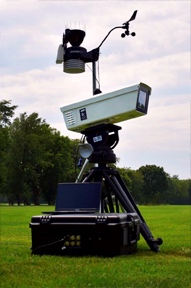
The CIRPAS Airborne Research Facility and the Laboratory for Environmental Effects on Naval Applications (LEENA), two laboratories within the Naval Postgraduate School's Department of Meteorology, showcased advanced atmospheric measurement capabilities that support electro-optical (EO) and directed-energy (DE) research and test and evaluation applications on Friday morning. Together, CIRPAS and LEENA provide complementary sensing capabilities to characterize the full atmospheric boundary layer using surface-based and airborne measurements.
A tour of the CIRPAS Airborne Research Facility was held on Friday morning. The research facility is based in an operational hangar at Marina Municipal Airport (3200 Imjin Rd., Suite A, Marina, CA 93933), approximately 20 minutes drive from the hotel. No transportation is provided. The tour was approximately one hour.
Both facilities have collected extensive METOC datasets during atmospheric and defense-focused field campaigns worldwide. These efforts have supported numerous NPS student theses, faculty research projects, and publications, and have enhanced the understanding of environmental impacts on US Navy operations. The tour included:
- CIRPAS Airborne Research Facility - De Havilland Twin Otter - A customized research aircraft configured for atmospheric science and environmental characterization missions. The Twin Otter carries a comprehensive suite of basic meteorological parameters, aerosol, radiation, and turbulence sensors with flexible mounting options for pod-, nose-, and wing-based payloads. It has supported numerous field studies relevant to EO/DE propagation and modeling. Recent modifications include a reinforced nose section to expand payload capacity and accommodate ISR-related instrumentation.
- LEENA Environmental Sensing Systems - Display of gimbal-mounted EO/IR sensors, LIDAR/SODAR profilers, and meteorological and turbulence instruments used to assess environmental effects on EO/DE propagation. These systems have been deployed concurrently with the Twin Otter and in support of directed-energy test events such as SSL-TM, HELIOS, and HELCAP.
- Outdoor Demonstration (weather permitting) - Live operation of the MZA DELTA-Wx system and supporting meteorological sensors for real-time environmental monitoring.
SPACECRAFT RESEARCH AND DESIGN CENTER (SRDC) LABORATORY TOUR
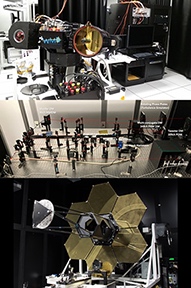
A tour was held on Monday of the Naval Postgraduate School Laboratory Spacecraft Research and Design Center (SRDC) hosted by Dr. Brij Agrawal, NPS Distinguished Professor in the Department of Mechanical and Astronautical Engineering and Director of Spacecraft Research and Design Center. SRDC laboratories are used for instruction and research in space system engineering and space operations curricula.
The emphasis of the SRDC has been on providing students with hands-on experience in the design, analysis, and testing of space systems and systems and to provide students facilities for experimental research. Learn more about the Laboratory here. The tour consisted of three testbeds:
- NPS High Energy Laser Beam Control Research Testbed (HBCRT) - It has a 30cm diameter telescope, acquisition sensor, and adaptive optics.
- Multi Conjugate Woofer-Tweeter Adaptive Optics Testbed - It consists of three deformable mirror and two wavefront sensor.
- Segmented Mirror Telescope - It consists of six segments, 3 m diameter, with 156 piezo actuators on each segments, 3 fine and 6 coarse actuators on each segments for alignment, FSM, and focal plane.
COMPANIONS
Companions are always welcome at any DEPS meeting. To make their experience enjoyable, we offer optional companion meal packages at an additional cost.
Full Meal Package - includes all meals provided to regular attendees, including any evening events or specialty functions.
Reception-Only Package - includes only admission to the Tuesday evening reception.
Companion tickets will be available for purchase once registration opens, and can be purchased with your symposium registration.